
Should You Hire an Organizational Development Consultant or a Full-Time Employee?
Your organization is at a crossroads. Maybe you're scaling rapidly and your current support can't keep up. Maybe you lost your People Director and you're not sure whether to replace them. Or maybe your culture needs rebuilding after a crisis.
The question keeps coming up: Do we hire a full-time employee or bring in a consultant?
It's one of the most important decisions you'll make. The wrong choice costs time, money, and momentum. This guide shows you exactly how to decide.
Understanding the Real Difference
Full-Time Organizational Development Employee
What they do:
Embedded full-time, handling operations AND strategy
Available for day-to-day questions and crisis management
Build institutional knowledge over time
Manage ongoing systems (performance reviews, training, succession planning)
Cost:
HR Director: $85,000–$130,000/year base salary
Plus benefits (30-40% of salary), recruiting, onboarding, overhead
Total Year 1: $157,000–$173,000
Ongoing: $143,000/year
Organizational Development Consultant
What they do:
Project-based or retainer partnerships
Strategic guidance, assessments, intervention design
Bring external perspective and cross-industry expertise
Train your team, then step back
No day-to-day operational responsibilities
Cost:
Hourly: $150–$350/hour
Project-based: $10,000–$100,000+ depending on scope
Retainer/Fractional: $4,500–$15,000/month
What's included: Culture audits, leadership development program design, training and facilitation, coaching, implementation support.
When to Hire a Full-Time Employee
Scenario 1: You Have Ongoing, High-Volume Operational Work
Signs this is you:
Hiring 5+ people per quarter
50+ employees, no one managing benefits or compliance
Managers asking HR questions daily
Hours spent weekly on employee relations
Need someone to own performance reviews, onboarding, offboarding
Why full-time works: Consultants can design your systems, but they won't run them. If the work is recurring and time-intensive, you need someone embedded in the day-to-day.
Example: A nonprofit scales from 30 to 75 employees in 18 months. The ED is fielding benefits questions, ops is running performance reviews, nobody has time for strategy. They need an HR Manager to take the operational load off leadership.
Scenario 2: You're Building Long-Term Institutional Capacity
Signs this is you:
Want to develop internal expertise, not rely on external partners
Have budget stability for multi-year investment
Value continuity and institutional knowledge
Want someone who grows with your organization
Why full-time works: Consultants leave. Employees stay. If institutional knowledge matters and you can afford it, hiring full-time builds capacity that compounds.
When to Hire a Consultant
Scenario 1: You're Facing a Specific, Time-Bound Challenge
Signs this is you:
Navigating crisis (leadership departure, culture breakdown, restructuring)
Need an equity audit or culture assessment
Implementing a new system (performance management, leadership development, conflict resolution)
6-12 month project with clear start and end
Why a consultant works: Hiring full-time for temporary needs doesn't make sense. By the time you recruit and onboard, the project's half over. Consultants come in, do the work, train your team, leave you with sustainable systems.
Example: A social impact org loses their Chief of Staff. Trust is low. They bring in an OD consultant for 6 months to facilitate difficult conversations, coach leadership, and design decision-making frameworks. Once systems are in place, the consultant steps back.
Scenario 2: You Need Expertise You Don't Have (and Don't Need Long-Term)
Signs this is you:
Designing your first leadership development program
Need to meet B Corp Fair Work standards
Addressing systemic inequity in hiring/promotion
Want external facilitation for strategic planning
Why a consultant works: Consultants bring cross-industry expertise and proven methodologies. They've done this with dozens of organizations. Hiring full-time means finding expensive expertise or training someone (time-consuming and risky). Consultants already know how. They design it, implement it, train your team to sustain it.
Scenario 3: You Need Objectivity and External Perspective
Signs this is you:
Leadership stuck in old patterns, needs outside perspective
Dealing with sensitive issues requiring neutrality
Want honest feedback; internal staff too close to see it
Need someone who can speak truth to power without job security concerns
Why a consultant works: Full-time employees have skin in the game. That makes full honesty harder, especially when feedback is uncomfortable. Consultants are external. They can say hard things without fear of being fired. They facilitate difficult conversations neutrally.
Scenario 4: You Can't Afford a Full-Time Senior Hire (Yet)
Signs this is you:
Budget is $50,000–$80,000 for people strategy
Need strategic leadership, not 40 hours/week of work
Startup or small nonprofit with limited capacity
Want senior expertise without $120,000+ commitment
Why a consultant works: Fractional or retainer models give you strategic support at a fraction of the cost. For $5,000–$10,000/month, you get 10-15 years of experience guiding your people strategy without full-time overhead.
The Cost Comparison
Full-Time HR Director
Base: $100,000
Benefits: $30,000
Taxes/recruiting/onboarding: $22,650–$37,650
Year 1 Total: $157,650–$172,650
Project-Based Consultant (6 months)
Assessment: $15,000
Program design: $10,000
Training: $18,000
Coaching: $12,000
Evaluation: $5,000
Total: $60,000
Fractional Consultant (12 months)
$6,500/month retainer
Includes: 2 strategy calls/month, unlimited support, quarterly pulse checks, coaching, crisis support
Annual Total: $78,000
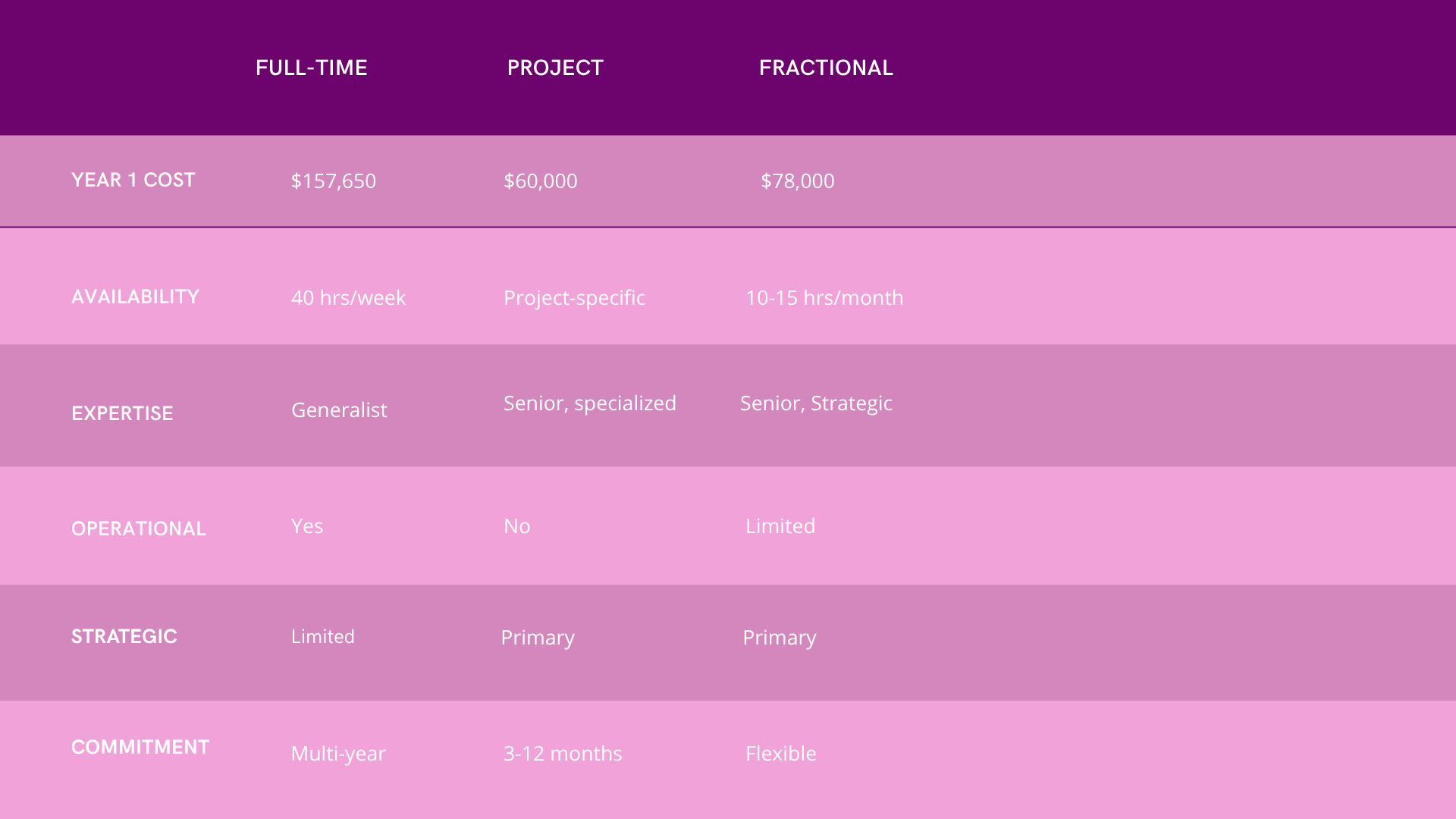
Side-by-Side
The Hybrid Model: Fractional Leadership
A fractional leader partners with your organization ongoing (10-20 hours/month). Not project-based—they become a strategic partner who knows you deeply.
What makes it different:
Proactive: they notice patterns, flag concerns, propose solutions
Decision-making partner: at the table for leadership decisions
Flexible: scale up during busy periods, down during stable times
What it's NOT:
Not operational (won't run payroll or process benefits)
Not full-time (strategic advisors, not embedded staff)
Not forever (goal is building your capacity to not need them)
Who this works for: Organizations with 30-150 employees who need strategic leadership but can't justify $120K+ full-time hire.
Example: A 60-person nonprofit has an HR Coordinator handling operations. But the ED makes all strategic people decisions on top of other responsibilities. They bring in a fractional strategist for $7,500/month who coaches the ED, designs leadership development, facilitates quarterly offsites. The coordinator handles operations, the ED gets time back, the org gets expertise they couldn't afford.
Questions to Ask Before You Decide
1. Is this need ongoing or temporary?
Ongoing (quarterly reviews, constant hiring, daily relations) → Full-time
Temporary (6-12 month project, system design, crisis) → Consultant
2. Do we need execution or guidance?
Execution (running programs, day-to-day HR, staff availability) → Full-time
Guidance (designing systems, facilitating change, coaching) → Consultant
3. What's our budget?
$120K+ annually → Full-time senior hire
$50K-$100K → Fractional/retainer
$25K-$50K → Project-based
4. Can we manage a new employee?
Hiring full-time means recruiting (2-3 months), onboarding (1-2 months), performance management, benefits admin.
Have capacity → Full-time manageable
Stretched thin → Consultant comes ready
5. How important is external perspective?
Need fresh eyes, honesty, cross-industry expertise → Consultant
Value continuity, institutional knowledge → Full-time
6. What's our risk tolerance?
Wrong full-time hire costs: 6-12 months salary, severance, recruiting replacement, lost momentum.
Wrong consultant costs: project fee (time-bound), can end contract and try another.
Can't afford mistakes? Start with a consultant, prove the model, then consider full-time.
Real-World Case Studies
When a Consultant Was Right
Organization: 80-person nonprofitChallenge: Lost Director of People & Culture. Culture fragile.Decision: 6-month OD consultant instead of rushing replacement
Outcome:
$55,000 vs. $140,000 for full-time
Leadership trust rebuilt
Managers trained
After 6 months, hired $65K HR Coordinator for operations (not Director)
Why it worked: Needed strategic intervention, not operational support.
When Full-Time Was Right
Organization: 120-person healthcare nonprofit scaling rapidlyChallenge: Hiring 30+ people/year, performance management falling throughDecision: Full-time HR Director
Outcome:
$150,000 annual investment
Recruiting time cut 40%
Retention improved 25%
Daily strategic HR access for leadership
Why it worked: Operational volume required full-time capacity.
When Fractional Was Perfect
Organization: 50-person government agencyChallenge: Needed strategic leadership, couldn't justify $120K+ hireDecision: Fractional strategist at $6,500/month
Outcome:
$78,000 vs. $150,000 for CPO
Senior expertise without full-time commitment
Flexibility to scale
After 18 months, promoted internal HR Coordinator, kept fractional strategist
Why it worked: Strategic leadership at affordable cost with flexibility.
What Happens If You Choose Wrong
Mistake #1: Hiring Full-Time When You Needed a Consultant
You hire an HR Director to "fix culture." Six months in, they've built systems but strategic work (facilitation, coaching, change management) isn't their strength. They're doing operational tasks. Strategic work isn't happening. You're paying $140K/year for what a $60K project could have done.
Real cost: $80K+ wasted, 6-12 months lost momentum, still need a consultant.
Mistake #2: Hiring a Consultant When You Needed Full-Time
You hire a consultant for "people strategy." They design great systems, facilitate workshops, leave solid recommendations. But no one implements them. The binder sits on a shelf. Six months later, nothing changed.
Real cost: $40K-$80K in fees with no impact because you lacked capacity to implement.
Making Your Decision: A Simple Framework
Step 1: Define primary need
"Too much HR work, no one to do it" → Full-time
"Culture/systems/leadership need intervention" → Consultant
"Need strategic guidance, can't afford full-time" → Fractional
Step 2: Assess capacity
Have capacity to implement? → Consultant designs, you execute
Maxed out? → Need ownership (full-time or fractional with more hours)
Step 3: Check timeline
Crisis mode? → Consultant starts faster
Can wait 3-6 months? → Time to recruit right full-time person
Step 4: Evaluate long-term vision
Want internal expertise? → Start with consultant to design, then hire full-time
Want flexibility and external perspective? → Fractional long-term
Not sure? → Short-term consultant to clarify
The Bottom Line
There's no universal answer. But successful organizations:
Get honest about what they actually need
Match solution to problem
Start with clarity before committing to cost
Build internal capacity over time
The question isn't "consultant or employee?" It's "What does our organization need right now to grow stronger, and what's the smartest way to get there?"
What To Do Next
Option 1: Book a Free Consultation
30-minute consultation to think through your specific situation. No sales pitch. Strategic guidance on what makes sense.
Option 2: Start with a Diagnostic Assessment
Not ready to commit? Start with a short diagnostic project.
Included: Stakeholder interviews, assessment of systems and gaps, clear recommendation, roadmap
Investment: $8,000-$12,000 | Timeline: 4-6 weeks
Option 3: Explore Fractional Leadership
Ongoing strategic support without full-time commitment.
Includes: 2 strategy calls/month, unlimited support, quarterly pulse checks, coaching, crisis support
Investment: Starting at $4,500/month (6-month minimum)
About Construct the Present
Portland-based Certified B Corporation specializing in leadership development and organizational culture consulting. We partner with nonprofits, government agencies, and social impact organizations at critical inflection points.
We've worked with: OnPoint Community Credit Union, Miller Knoll, Metro Regional Government, Path Home, Portland Trail Blazers
